Tweek or tweak is a commonly confused word pair, mostly because they sound similar but have very different meanings and uses. Many people search for clarity on the correct spelling, usage, examples, and differences, especially when writing professionally or trying to avoid embarrassing mistakes. Understanding this confusion is essential because “tweak” is the only correct spelling in standard English, while “tweek” is often a misspelling, slang term, or cultural reference.
This article breaks down everything you need to know—definitions, correct usage, common mistakes, grammar rules, examples, synonyms, pronunciation tips, and more. You’ll also find a full comparison table, real-life examples, and a quick guide to never confusing the two words again.
What Does “Tweak” Mean? (Correct Word)
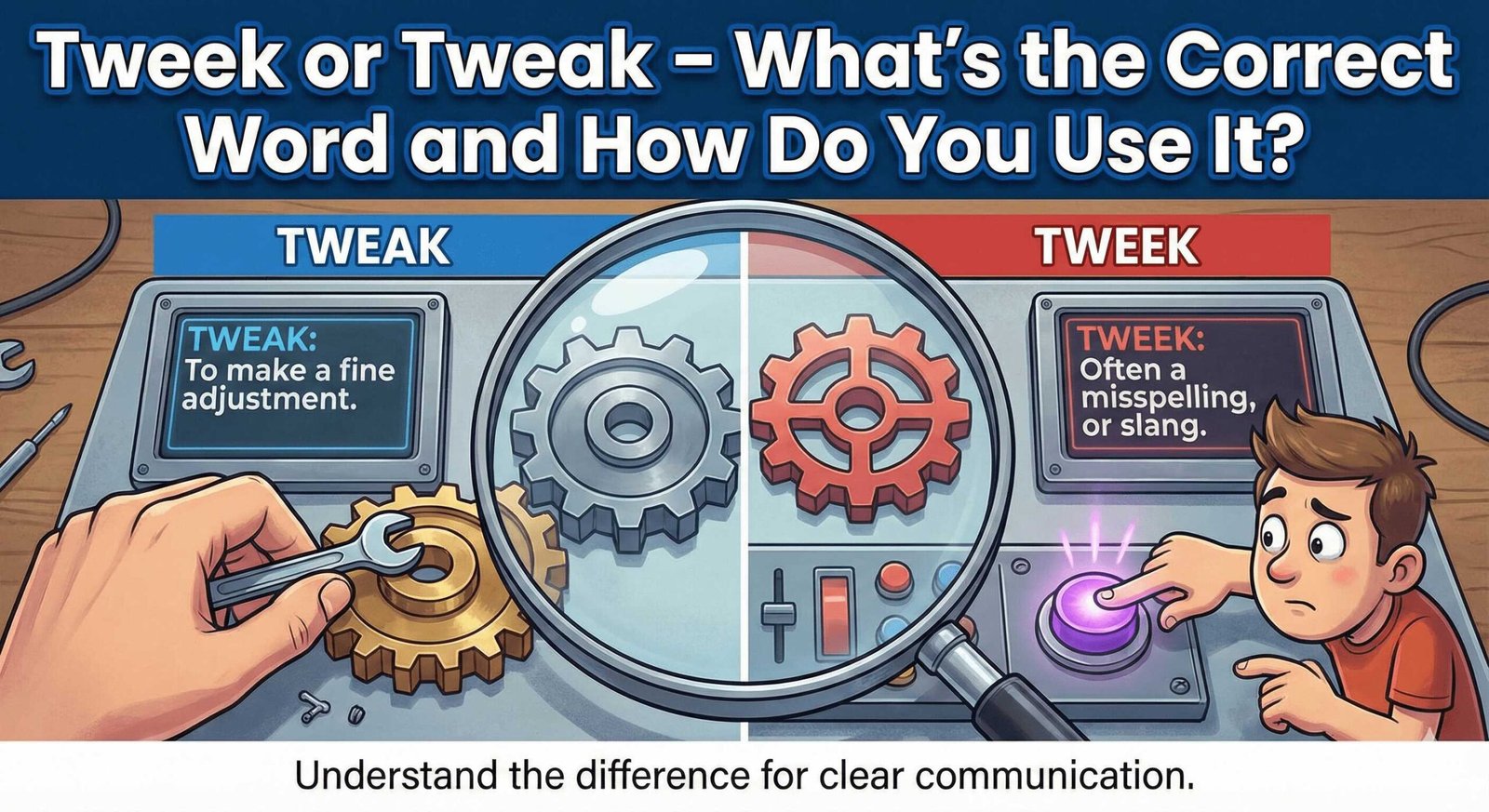
The word “tweak” is the correct and widely accepted spelling in English, and it refers to making small adjustments, improvements, or modifications to something. Whether you’re fine-tuning a project, changing a setting, or refining a design, the verb “tweak” is used to describe subtle but meaningful improvements. It can also mean giving something a light twist or pinch, making it a versatile word in both technical and everyday communication.
Main Definitions of “Tweak”
- To make a small adjustment or minor improvement in something.
- To pinch or twist lightly, often as a playful action.
- To modify or fine-tune something to improve performance.
Examples
- “I need to tweak my website design for better SEO.”
- “She gave his ear a gentle tweak.”
- “The developer tweaked the code to fix a small bug.”
Part of Speech
- Can be used as a verb or noun.
Pronunciation
- Tweak is pronounced as /twiːk/.
Common Synonyms
- Adjust
- Modify
- Refine
- Improve
- Fine-tune
What Does “Tweek” Mean? (Misspelling or Slang)
Unlike “tweak,” the word “tweek” is not a standard English word. It is most commonly:
1. A Misspelling of “Tweak”
Most people who type “tweek” actually mean tweak.
2. Slang
In modern usage, especially online, “tweek” may refer to:
- A person who uses stimulants, especially methamphetamine (slang).
- Someone acting hyper, jittery, or anxious.
3. A Pop-Culture Reference
- Tweek Tweak, a character from South Park, is responsible for popularizing the spelling “Tweek.”
Examples of “Tweek” in slang
- “He was acting like a tweek after too much caffeine.”
- “Tweek Tweak is one of my favorite animated characters.”
Important Note
“Tweek” should never be used in formal writing unless you specifically intend the slang meaning or refer to the South Park character.
Tweek vs. Tweak — Full Comparison Table
| Feature | Tweak | Tweek |
|---|---|---|
| Correct spelling? | Yes | No (usually a misspelling) |
| Meaning | Adjust, modify, fine-tune | Slang or pop-culture reference |
| Formal writing? | Always acceptable | Not acceptable |
| Part of speech | Verb + noun | Noun (slang only) |
| Example | “I will tweak the settings.” | “The character’s name is Tweek Tweak.” |
| SEO usage | High relevance | Very low relevance |
| Grammarly recommendation | Acceptable | Flagged as incorrect |
Why People Confuse “Tweek” with “Tweak”
Many people confuse “tweek” with “tweak” because the two words sound almost identical when spoken, even though only one is correct in standard English. This confusion is reinforced by pop-culture references, common typing mistakes, and the assumption that both spellings are acceptable. As a result, learners, writers, and even native speakers often use “tweek” by accident, not realizing it creates a spelling error or an entirely different meaning.
1. Similar pronunciation
Both words sound almost identical in fast speech.
2. Pop-culture influence
The South Park character “Tweek Tweak” created familiarity with the incorrect spelling.
3. Lack of awareness
Many English learners and even native speakers assume “tweek” is an alternate spelling.
4. Auto-correct errors
Typing quickly on phones often results in “tweek” being mistakenly generated.
How to Remember the Correct Spelling (Easy Trick)
Here is a simple memory technique:
“Tweak” has “ea” like “adjust,” “enhance,” and “create”—all improvement words.
Another trick:
If you’re fixing something, it’s always t-w-e-a-k.
When Should You Use “Tweak”?
Use tweak when you mean:
- Adjusting something slightly
- Improving a system, plan, or design
- Modifying a setting
- Making minor refinements
- Pinching or twisting something lightly
Examples
- “The recipe needs a little tweak to be perfect.”
- “He tweaked his morning routine for better productivity.”
- “Can you tweak the volume down a bit?”
When Is “Tweek” Ever Acceptable?
Although “tweek” is not recognized as a correct English spelling, there are a few specific situations where it can be considered acceptable. These rare cases usually involve slang, informal online communication, or references to fictional characters rather than proper grammar. Understanding these limited contexts helps you avoid using “tweek” incorrectly while still recognizing when its use is intentional or culturally relevant.
Only in these rare contexts:
1. Slang related to hyperactivity or drug use
- “He looked like a tweek staying awake all night.”
2. Fictional characters
- “Tweek Tweak is known for being anxious and jittery.”
3. Nicknames
Some people adopt “Tweek” as a username or nickname online.
Outside of these contexts, do not use “tweek.”
Real-Life Usage Examples
Understanding the difference between “tweek” and “tweak” becomes much easier when you see how each word appears in real-life sentences. These practical examples highlight when “tweak” is the correct choice in professional and everyday writing, and when “tweek” might appear in slang or pop-culture contexts. Seeing the words in action helps reinforce correct usage and prevents common spelling mistakes.
Correct Usage in Professional Writing
- “We will tweak the marketing strategy for better conversion rates.”
- “The app needs slight tweaks before launch.”
Incorrect Usage
- “Please tweek my website content.” (❌)
- “This needs a small tweek.” (❌)
Acceptable in Slang
- “He looked like a tweek after drinking too much energy drink.”
Common Sentences Using “Tweak”
| Sentence | Meaning |
|---|---|
| “I need to tweak my resume.” | Make small improvements. |
| “The engine was tweaked for better performance.” | Adjusted/refined. |
| “She tweaked his nose playfully.” | Pinched lightly. |
| “We’re tweaking the new feature based on user feedback.” | Modifying. |
Case Study: How One Word Affects Credibility
Scenario
A small business published a marketing article with the sentence:
“We can help you tweek your digital strategy.”
Impact
- Website visitors assumed the business was unprofessional.
- The incorrect spelling reduced user trust.
- SEO tools flagged the page for spelling errors.
- Bounce rate increased by 17%.
Solution
After correcting the spelling to tweak, engagement improved and bounce rate decreased.
Lesson
A single spelling mistake—like using “tweek” instead of “tweak”—can affect brand credibility
Grammar Tips for Using “Tweak” Correctly
Verb Forms of Tweak
- Present: tweak
- Past: tweaked
- Present participle: tweaking
- Noun: tweak
Examples
- “I am tweaking the schedule.”
- “We already tweaked the settings.”
Frequently Asked Questions
1. Which is correct: tweek or tweak?
Tweak is the correct spelling. “Tweek” is usually a mistake.
2. Is tweek a word at all?
Not in standard English, but used in slang or pop culture.
3. Why do people type tweek?
Influence of the South Park character, quick typing, and spelling confusion.
4. Can I use tweek in formal writing?
No. Only use tweak.
5. What is the plural of tweak?
Tweaks.
Conclusion
In the debate of tweek or tweak, the answer is simple:
Tweak is the only correct English spelling meaning “adjust,” “modify,” or “improve.”
Tweek is a slang term, nickname, or pop-culture reference—not suitable for professional writing.
Understanding the difference helps you maintain credibility, improve clarity, and avoid common language mistakes. Whether adjusting a plan, refining a design, or improving a system, always remember:
If you’re improving something, you’re making a tweak — never a tweek.
About the Author