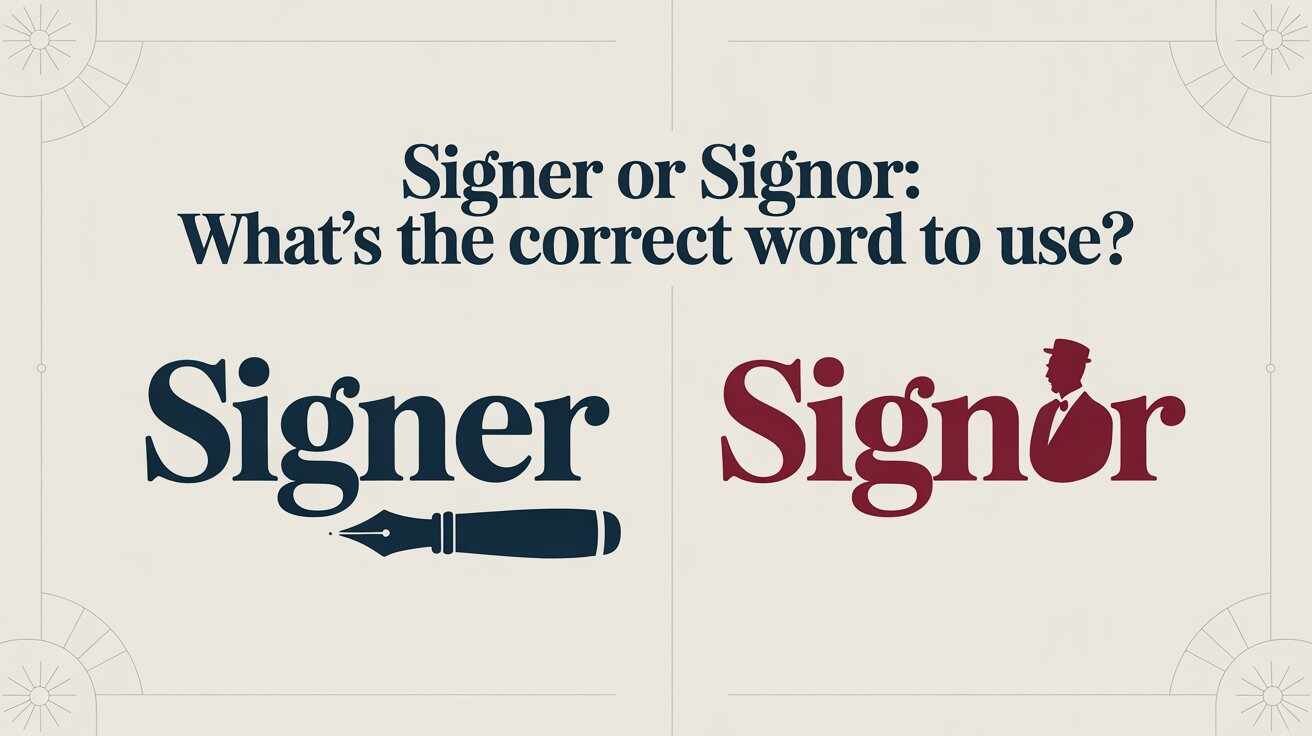
Signer or Signor is a phrase that confuses many people, especially those learning English or dealing with legal documents. While both words sound similar, their meanings and usage are completely different. One refers to someone who signs documents, while the other is an Italian honorific title, similar to “Mister.” This guide will break down everything you need to know about signer vs signor, including definitions, examples, tables, case studies, pronunciation, and common mistakes.
By the end, you’ll confidently know when to use signer and when to use signor, and you’ll avoid the common errors that appear in legal, business, and everyday contexts.
What Does “Signer” Mean?
A signer is a person who signs a document, contract, agreement, or letter. This term is commonly used in legal, business, banking, and government contexts. Whenever a signature is required, the individual providing it is the signer.
For example, a person signing a check, loan agreement, or consent form is considered the signer. This word comes from the Latin root “signare,” meaning to mark or sign.
In short, a signer is someone who provides authorization through their signature.
Examples of Signer in Sentences
- The signer of the contract must be present during notarization.
- Only an authorized signer can approve the bank transaction.
- Each signer on the agreement is legally responsible for the obligations.
- The company required three signers for the board resolution.
- He acted as the signer for his parents’ official documents.
Origin and Etymology of “Signer”
The word signer derives from the Latin “signare,” which means to mark, seal, or sign. In modern English, it specifically refers to someone who officially signs documents, making them legally binding.
How “Signer” Is Used in Legal, Business & Government Documents
In legal and business contexts, signers have specific responsibilities. They may act as:
- Authorizers of contracts or agreements
- Witnesses to legal acts
- Endorsers of banking and financial documents
Using the word signer correctly ensures clarity and avoids legal misunderstandings.
What Does “Signor” Mean?
Signor is an Italian word used as a polite form of address, equivalent to “Mister” in English. It is used before a man’s last name to show respect. For example, Signor Rossi means Mr. Rossi in English.
Unlike signer, signor is not related to signing documents. Confusion often arises because it sounds similar, but its usage is entirely different.
Origin and Etymology of “Signor”
The word signor comes from the Italian “signore,” meaning lord or gentleman. Over time, it became a standard honorific used in Italy to address men politely. It is rarely used in English except in formal, historical, or cultural contexts.
Examples of Signor in Sentences
- Signor Bianchi will attend the meeting tomorrow.
- The letter was addressed to Signor De Luca.
- In Italy, it is customary to greet a man as Signor followed by his surname.
- Signor Rossi is the owner of the famous restaurant.
- She met Signor Moretti at the opera last evening.
READ MORE >>> Scrapped or Scraped: Meaning, Difference, Usage & Common Mistakes
Signer vs. Signor: What’s the Difference?
The main difference is simple:
| Feature | Signer | Signor |
|---|---|---|
| Meaning | Person who signs a document | Italian honorific title (Mister) |
| Origin | Latin “signare” | Italian “signore” |
| Usage | Legal, business, official documents | Italian culture, literature, formal address |
| Examples | Authorized signer, contract signer | Signor Rossi, Signor Bianchi |
| Grammar | Noun | Noun / Title |
In short, signer is a legal/official term, while signor is a cultural title. Confusing the two in formal writing can lead to serious miscommunication, especially in contracts or legal documents.
When to Use “Signer” (Correct Usage Guide)
Use signer whenever you are referring to a person providing a signature. This is common in:
- Legal contracts
- Banking agreements
- Government forms
- Consent letters
- Notarized documents
Correct Usage in Legal English
- “The signer must bring a valid ID.”
- “Each signer agrees to the terms and conditions.”
Usage in Banking and Contract Signing
- “Only authorized signers can withdraw funds.”
- “The loan document requires signatures from all signers.”
When to Use “Signor” (Correct Usage Guide)
Use signor when addressing or referring to a male Italian person politely. This is appropriate in:
- Italian letters
- Formal introductions
- Cultural or historical references
- Literature, opera, or Italian media
Correct Usage in Italian Culture
- “She greeted Signor Moretti with a handshake.”
- “Signor Rossi lives in Rome.”
Usage in English Literature & Courtesy Titles
- “In the novel, Signor Bianchi is a wealthy merchant.”
- “The opera program listed Signor Giuseppe as the conductor.”
Common Mistakes People Make (With Fixes)
Many people confuse signer and signor, especially in writing or formal documents. Typical errors include:
- Using signor to refer to a person who signs a document
- Using signer as a title before someone’s name
Mistakes and Correct Usage Table
| Incorrect | Correct |
|---|---|
| The signor of the contract must approve. | The signer of the contract must approve. |
| I met Signer Rossi at the restaurant. | I met Signor Rossi at the restaurant. |
| Each signor on the check is legally responsible. | Each signer on the check is legally responsible. |
Grammar Rules You Must Follow
- Signer is always a noun and refers to the person performing the action of signing.
- Signor is used before a surname and should be capitalized when used as a title.
- Do not mix them, especially in legal, banking, or official contexts.
Real-Life Case Study: How “Signer” vs. “Signor” Causes Confusion
Maria, a bank officer, received a form signed by Signor Smith. She initially assumed he was an Italian client due to the title and delayed processing. Later, she realized it was meant to indicate a legal signer, not a cultural title.
Another example: In a contract, a clerk wrote Signor Jones instead of Signer Jones, causing confusion in approvals and legal responsibility.
These examples highlight the importance of using the correct term to avoid misinterpretation.
Pronunciation Guide
| Word | IPA | Rhymes With |
|---|---|---|
| Signer | /ˈsaɪnər/ | finer, diner |
| Signor | /siˈnɔːr/ | Señor, décor |
Tip: Signer stresses the first syllable, while Signor stresses the second syllable.
Quick Reference Table (Cheat Sheet)
| Feature | Signer | Signor |
|---|---|---|
| Meaning | Person who signs documents | Italian honorific title (Mister) |
| Origin | Latin “signare” | Italian “signore” |
| Context | Legal, business, official | Cultural, literature, formal address |
| Examples | Contract signer, authorized signer | Signor Rossi, Signor Bianchi |
| Grammar | Noun | Noun / Title |
| Synonyms | Signatory, endorser, validator | Mister, Sir, Gentleman |
Synonyms & Alternatives
Synonyms for “Signer”
- Signatory
- Endorser
- Approver
- Validator
- Witness
Synonyms for “Signor”
- Mister
- Sir
- Gentleman
- Signore (formal Italian)
- Master (historical/literary context)
Sentence Examples of “Signer” and “Signor”
Examples of “Signer”
The signer of the check is legally responsible.
Each signer must present valid identification.
The board requires three signers for the resolution.
He acted as a signer for his parents’ documents.
Authorized signers can approve withdrawals.
Examples of “Signor”
Signor Rossi attended the cultural event.
She greeted Signor Bianchi politely.
The letter was addressed to Signor De Luca.
In the opera, Signor Giuseppe performed the lead role.
Signor Moretti is a respected businessman in Italy.
FAQs About “Signer” and “Signor”
Is “Signor” still used today?
Yes, but mainly in Italian cultural contexts or historical references. It is rarely used in modern English outside Italy.
Is “Signer” the same as a signature holder?
Yes. A signer is the person who provides the signature on a document, contract, or official form.
Which one is grammatically correct?
Both are correct in their own context. Use signer for signing actions and signor for polite address of an Italian man.
Why do Italians use “Signor”?
It is a formal title to show respect, similar to “Mister” in English.
Is “Signor” formal or informal?
It is formal and should be used in polite, professional, or traditional contexts.
About the Author