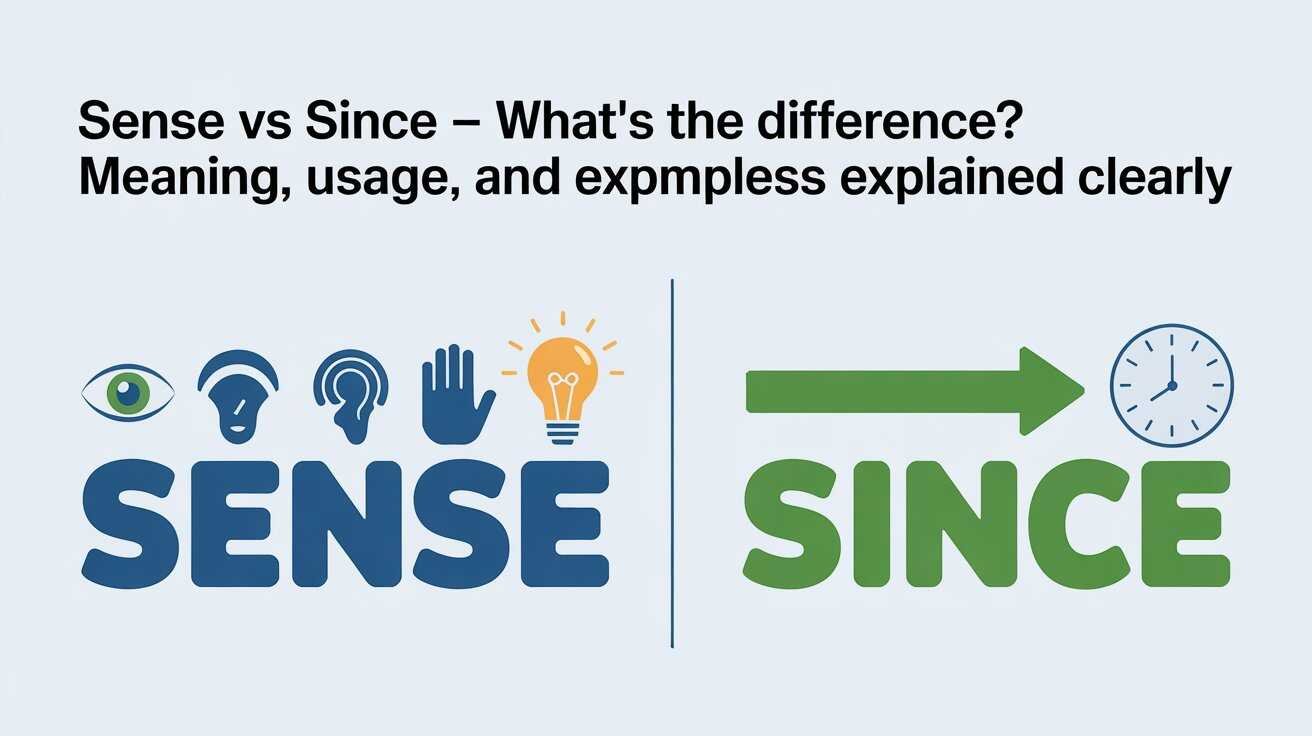
Sense vs since is one of the most confusing word pairs in English. They look similar, sound similar, and often appear in sentences that talk about ideas, logic, or reasons. Because of this, many people—especially ESL learners, students, and content writers—use them incorrectly without realizing it.
In this guide, you’ll learn the difference between sense and since, their meanings, grammar roles, correct usage, and common mistakes. By the end, you’ll know when to use sense and when to use since with confidence, using clear examples that feel natural and easy to understand.
Why Do People Confuse Sense and Since?
The confusion between sense vs since happens for a few clear reasons. First, both words sound almost the same when spoken quickly. Second, they are often used in abstract situations, not physical actions. Third, many languages use one word to express meanings that English separates into “sense” and “since.”
Another big reason is that since is often overused in spoken English. People use it casually, even when it doesn’t fit grammatically. Over time, this habit creates confusion, especially for learners trying to master English grammar.
As one English teacher famously said:
“Most grammar mistakes happen not because rules are hard, but because habits are stronger.”
Meaning of Sense in English Grammar
What Does “Sense” Mean?
Sense relates to meaning, understanding, feeling, or awareness. It refers to how we perceive, understand, or interpret something. It never talks about time.
In simple words, sense is about perception or understanding.
Parts of Speech of Sense
The word sense can function as both a noun and a verb.
As a noun, it refers to meaning, logic, or physical perception.
As a verb, it means to feel or become aware of something.
Common Uses of Sense
Sense is commonly used in these situations:
- Talking about understanding or logic
- Describing physical senses (sight, smell, touch, taste, hearing)
- Expressing intuition or awareness
Example Sentences Using Sense
Here are correct examples:
- This explanation makes perfect sense.
- I had a strange sense that something was wrong.
- She can sense danger from far away.
Incorrect example:
- ❌ I sense five years ago.
Corrected: - ✅ I met her five years ago.
This mistake happens because sense cannot be used for time.
Meaning of Since in English Grammar
What Does “Since” Mean?
Since is mainly used to talk about time or reason. It often answers two questions:
- From when?
- Because why?
Parts of Speech of Since
Since can function as:
- A conjunction
- A preposition
- An adverb
Common Uses of Since
There are two main uses of since:
- Time reference – from a point in the past until now
- Cause or reason – similar to “because”
Example Sentences Using Since
Time-based examples:
- I have lived here since 2015.
- She hasn’t called me since Monday.
Reason-based examples:
- Since it was raining, we stayed home.
- He left early since he wasn’t feeling well.
Incorrect example:
- ❌ This idea since good.
Corrected: - ✅ This idea makes sense.
It Makes Since or Sense?
The correct phrase is “It makes sense.”
❌ It makes since is incorrect.
Here’s why:
- Sense refers to meaning, logic, or understanding.
- The phrase “make sense” means to be logical or understandable.
Correct examples:
- It makes sense to save money every month.
- Her explanation makes perfect sense.
- That decision doesn’t make any sense.
Incorrect example:
- ❌ It makes since to wake up early.
Why it’s wrong:
Since never expresses meaning or logic. It only refers to time or reason.
👉 Rule to remember:
If you can replace the word with “meaning” or “logic,” the correct choice is sense.
READ MORE >>> ‘Journeys or Journies – Correct Plural, Meaning, and Usage
Since vs Sense Examples (With Clear Context)
Understanding since vs sense becomes much easier when you see them in real sentences.
Examples Using Sense
- This rule makes sense now.
- I had a strong sense that something was wrong.
- She can sense danger easily.
Examples Using Since
- I’ve lived here since 2018.
- Since it was late, we went home.
- He hasn’t replied since yesterday.
Side-by-side comparison:
- This idea makes sense. ✅
- I’ve believed this idea since childhood. ✅
👉 Notice how sense = meaning, while since = time or reason.
Since vs Sense Pronunciation
Many people confuse sense vs since because their pronunciation is very similar, especially in fast speech.
Here’s how they sound:
- Sense → /sens/
- Since → /sɪns/
Pronunciation tip:
- Sense has a short “e” sound (like pen).
- Since has a short “i” sound (like sit).
In casual conversation, these sounds blend together, which explains why even native speakers mix them up. In writing, however, the difference matters a lot.
Sense vs Since Quiz (Test Yourself)
Choose the correct word in each sentence.
- This explanation doesn’t make any ____.
- I haven’t talked to her ____ Monday.
- ____ it was raining, the match was canceled.
- He has a good ____ of direction.
- I’ve known him ____ college days.
Answers:
- sense
- since
- Since
- sense
- since
Quick tip:
If the sentence talks about meaning or understanding, choose sense.
If it talks about time or reason, choose since.
Sense vs Since – Key Differences Explained Simply
Understanding sense vs since becomes easy when you remember one simple rule:
Sense is about meaning or feeling.
Since is about time or reason.
Here’s the difference explained clearly:
- Sense explains what something means or how it feels.
- Since explains when something started or why something happened.
They are not interchangeable, and replacing one with the other usually breaks the sentence.
Sense vs Since Comparison Table
| Feature | Sense | Since |
|---|---|---|
| Main meaning | Understanding or perception | Time or reason |
| Part of speech | Noun / Verb | Conjunction / Preposition / Adverb |
| Used for time | ❌ No | ✅ Yes |
| Used for reason | ❌ No | ✅ Yes |
| Related to feelings | ✅ Yes | ❌ No |
| Common mistake | Used instead of since | Used instead of sense |
How to Choose Between Sense and Since (Quick Rules)
If you’re unsure which word to use, try these quick rules.
Ask yourself:
- Am I talking about meaning or understanding? → Use sense
- Am I talking about time or reason? → Use since
Another helpful trick is the substitution test:
- If you can replace the word with “because,” use since.
- If you can replace it with “meaning” or “understanding,” use sense.
Common Mistakes With Sense vs Since
One of the most common mistakes is using since when sense is needed.
Example:
- ❌ This rule since important.
- ✅ This rule makes sense.
Another mistake is using sense to talk about time.
Example:
- ❌ I sense last year.
- ✅ I moved here last year.
These errors are especially common among ESL learners and in casual writing.
Sense vs Since in Daily Conversation
In spoken English, people often misuse since because it sounds natural in fast speech. Native speakers may say incorrect sentences without realizing it, and learners copy those patterns.
However, in writing, grammar mistakes stand out more. That’s why understanding sense vs since is especially important for:
- Academic writing
- Blog posts
- Professional emails
- Exams like IELTS or TOEFL
Sense vs Since for ESL Learners
For ESL learners, sense vs since can feel confusing at first. The key is practice and exposure.
A helpful learning tip is to associate:
- Sense with your brain or feelings
- Since with a timeline or reason
Think visually. If you can draw a timeline, use since. If you’re talking about understanding, use sense.
Practice Sentences: Sense vs Since
Choose the correct word:
- This explanation doesn’t make any ____.
- I haven’t seen her ____ last summer.
- He left early ____ he felt tired.
Answers:
- sense
- since
- since
Mini Case Study: Why This Confusion Matters
A student once wrote in an exam:
“I didn’t attend the class sense I was sick.”
The examiner marked it wrong—not because the idea was unclear, but because sense changed the grammar. The correct sentence was:
“I didn’t attend the class since I was sick.”
Small mistakes like this can affect grades, credibility, and clarity.
FAQs About Sense vs Since
Is “since” used for time or reason?
It is used for both, depending on context.
Can “sense” be used for time?
No. Sense never refers to time.
Is “since” formal or informal?
It works in both, but in very formal writing, “because” is sometimes preferred.
Why do people confuse sense and since?
Because of similar sounds, habits, and translation issues.
Final Summary: Sense vs Since Made Simple
To sum it up:
- Sense = meaning, understanding, feeling
- Since = time or reason
Once you understand this difference, your writing becomes clearer, more confident, and more professional. Grammar isn’t about memorizing rules—it’s about making your message easy to understand.
If something feels right logically, it probably makes sense.
If something started in the past or happened for a reason, use since.
And just like that, the confusion disappears.
About the Author