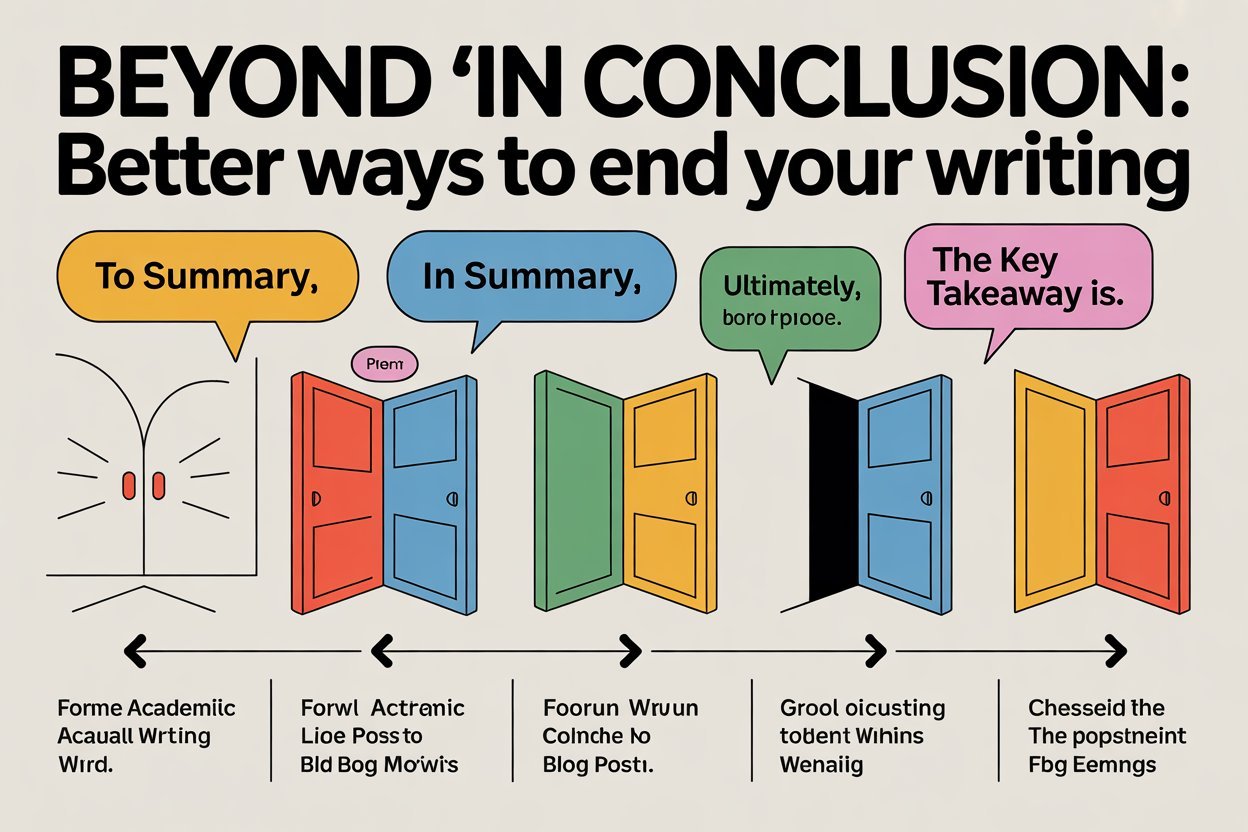
Other Ways to Say In Conclusion
Other ways to say in conclusion (and many more helpful phrases too)
Have you ever finished writing something and felt stuck on the last line? You know what you want to say, but your brain keeps repeating the same old words. That’s when people type other ways to say in conclusion into Google. And honestly, it makes sense. The ending is important. It’s the last thing your reader sees. It’s the moment where you leave a final thought, a final feeling, or a final push. A strong closing can make your message feel complete, confident, and easy to remember. The good news is you don’t need big words to do it. You just need the right phrase for the right moment. In this guide, you’ll learn many simple ways to close essays, emails, stories, and speeches. You’ll also learn better choices for everyday phrases, like greetings and thank you lines, so your writing feels fresh and alive.
'/%3E%3Crect width='1600' height='800' fill='url(%23g1)'/%3E%3Crect width='1600' height='800' fill='url(%23g2)'/%3E%3Cpath d='M120 640 C420 520, 720 760, 1040 640 S 1480 520, 1520 640' stroke='%23caa6ff' stroke-opacity='0.35' stroke-width='8' fill='none'/%3E%3Cpath d='M140 600 C440 480, 740 720, 1060 600 S 1500 480, 1540 600' stroke='%23b98cff' stroke-opacity='0.22' stroke-width='6' fill='none'/%3E%3Cpath d='M160 560 C460 440, 760 680, 1080 560 S 1520 440, 1560 560' stroke='%238a2be2' stroke-opacity='0.18' stroke-width='5' fill='none'/%3E%3Cg filter='url(%23blur)'%3E%3Ccircle cx='360' cy='220' r='80' fill='%23b98cff' fill-opacity='0.35'/%3E%3Ccircle cx='1260' cy='260' r='90' fill='%238a2be2' fill-opacity='0.25'/%3E%3C/g%3E%3Cpath d='M740 520 q60-100 120 0 v160 q-60 60-120 0z' fill='%23ffffff' fill-opacity='0.06'/%3E%3Cpath d='M760 520 q40-70 80 0 v150 q-40 45-80 0z' fill='%23caa6ff' fill-opacity='0.10'/%3E%3C/svg%3E)
Why your closing line matters so much
Your closing line is like the final bite of a meal. If it tastes good, you feel happy. If it feels rushed, you notice. Many people use the same ending again and again because it feels safe. But safe endings can sound boring. When you learn other ways to say in conclusion, you give yourself more choices. You can sound calm, strong, polite, or inspiring. You can match the mood of your message. In school writing, the ending helps your teacher see your point clearly. In emails, the ending helps the reader understand what you want next. In stories, the ending helps the reader feel something. So yes, the ending matters. It can turn an “okay” piece of writing into something that feels complete. It can also make you sound more confident, even if you’re still learning.
Other ways to say in conclusion (best options for most writing)
Strong, simple closers
- To sum it up, a quick way to restate your main idea.
- In summary, clean and perfect for school writing.
- All in all, friendly and warm for casual writing.
- In the end, great for stories and reflective points.
- Overall, neat for reviews, reports, and guides.
- To wrap things up, friendly for blogs and emails.
Closing lines that feel confident
- In closing, calm and professional for emails or speeches.
- Putting it simply, great when you want clarity.
- The key takeaway is… perfect for tips and how-to posts.
- The main point is… strong for essays and arguments.
- At the end of the day, casual but powerful.
- So, it’s clear that… strong for evidence-based writing.
When to use each ending phrase (quick guide)
Not every ending phrase fits every situation. Some phrases sound better for essays. Some feel better for friendly messages. Some fit speeches or presentations. Choosing the right one helps your writing feel natural. That’s why it’s helpful to understand the vibe of each option. If you use a very formal ending in a casual email, it can feel stiff. If you use a very casual ending in a school essay, it can feel careless. This section helps you match your ending to the moment. Learning other ways to say in conclusion is not just about collecting phrases. It is about using them in the right place. And once you practice a few times, it becomes easy.
Essays
Try In summary, Overall, and The main point is… when you want a neat, clear finish.
Emails
Use To wrap things up and In closing to sound polite and organized.
Speeches
Choose To finish and Here’s what matters most to end with energy.
Detailed table: closing phrases and when they work best
| Closing Phrase (Alternative) | Best For | Example Sentence |
|---|---|---|
| To sum it up | Essays, blogs | “To sum it up, small habits lead to big change.” |
| In summary | School writing | “In summary, teamwork improves results.” |
| Overall | Reports, reviews | “Overall, the plan is smart and realistic.” |
| All in all | Friendly writing | “All in all, it was a great trip.” |
| In closing | Emails, speeches | “In closing, thank you for your time.” |
| To wrap things up | Blogs, emails | “To wrap things up, focus on what matters.” |
| The key takeaway is | Guides, how-to | “The key takeaway is to start small.” |
| The main point is | Essays | “The main point is that practice matters.” |
| In the end | Stories, essays | “In the end, kindness wins.” |
| Putting it simply | Any style | “Putting it simply, it’s worth it.” |
| So, it’s clear that | Essays | “So, it’s clear that sleep affects learning.” |
| For these reasons | Essays | “For these reasons, we should recycle more.” |
| As a final thought | Speeches | “As a final thought, choose courage.” |
| Finally | Many formats | “Finally, remember to review your work.” |
Other ways to say this shows (and this shows in an essay)
Sometimes your conclusion feels weak because your evidence sentences are weak. Many students repeat the phrase “this shows” again and again. That’s normal, but it can make writing feel robotic. You can keep the meaning and still sound fresh. If you write essays, you may also search other ways to say this shows in an essay because teachers like variety and clarity. The trick is to choose phrases that clearly connect evidence to your point. A good replacement does not hide your meaning. It makes it stronger. Use these options when you explain what a quote, fact, or example proves. When your evidence sounds stronger, your ending also becomes stronger.
- This proves that… Use when the evidence feels strong and direct.
- This suggests that… Use when the evidence points to an idea.
- This highlights… Use when you want to draw attention.
- This demonstrates… Great for essays and clear explanation.
- This makes it clear that… Strong and easy for readers.
- This supports the idea that… Perfect for school writing.
- This points to… Short and smooth for quick linking.
- This reveals… Useful for stories and character analysis.
Other ways to say for example (so your writing flows better)
Examples help readers understand fast. But repeating “for example” too often can make your writing feel flat. Learning other ways to say for example keeps your writing fresh while staying clear. These phrases work in essays, blog posts, and casual writing. Some sound more formal, and some sound more friendly. When you add examples the right way, your writing feels helpful, not messy. Use one example at a time, and explain it clearly. That way the reader doesn’t get lost. A great example can also make your conclusion stronger, because it reminds the reader of what your point looks like in real life.
Easy swaps
- For instance, a clean replacement that fits most writing.
- Such as, perfect when listing examples.
- Like, best for friendly tone.
- One example is… clear and direct for school writing.
Stronger, more vivid options
- To illustrate, good for explaining a point.
- Here’s an example: friendly and simple.
- Take this case: useful for real scenarios.
- Imagine this: great for storytelling.
Other ways to say according to (without sounding repetitive)
When you mention sources, it builds trust. It shows you did your homework. But repeating “according to” can get boring. That’s why learning other ways to say according to is helpful for essays and informative writing. You can keep your writing clean while still giving credit. Just keep it honest and accurate. The goal is to share information clearly. When you use sources in a simple way, readers feel safer trusting your message. It also makes your conclusion stronger because you are not just giving an opinion. You are showing support for your point.
- Based on… Good for facts, results, and data.
- As stated by… Great when you are quoting a person.
- As reported by… Useful for news or reports.
- As noted by… Smooth and professional.
- Research from… shows… Strong and clear for evidence.
- Data from… suggests… Great when results are not absolute.
Other ways to say because (clear reasons, strong writing)
Reasons are the heart of good writing. But repeating “because” can make your sentences feel boring, even when your ideas are smart. Learning other ways to say because helps your sentences flow. Some options are short and simple. Others sound slightly more formal. Pick what feels natural. The best writing is not about fancy words. It is about clear meaning. When your reasons are clear, your ending becomes stronger too. It helps your reader think, “Yes, that makes sense.” And that’s a great feeling to leave behind in your conclusion.
| Alternative | Best Use | Example |
|---|---|---|
| Since | Everyday writing | “Since we have time, let’s review.” |
| As | Smooth, simple tone | “As it was late, we left early.” |
| Due to | Formal writing | “Due to the rain, the game ended.” |
| For this reason | Essays | “For this reason, planning helps.” |
| That’s why | Friendly tone | “That’s why I practice daily.” |
| Thanks to | Positive reasons | “Thanks to support, she improved.” |
Other ways to say said (better dialogue and stronger stories)
If you write stories or add quotes, you might repeat “said” often. Sometimes “said” is fine because it stays quiet and does not distract. But too much of it can feel dull. Learning other ways to say said helps when you want emotion. The secret is balance. Use stronger words only when the moment needs it. If every sentence uses a dramatic word, your writing can feel forced. Instead, pick a few moments where emotion matters most. That makes your writing feel real and easy to follow. It also makes your conclusion feel more alive because your writing has better rhythm.
- Asked “She asked if we could start now.”
- Replied “He replied with a calm smile.”
- Explained “The teacher explained the steps.”
- Whispered “She whispered the secret.”
- Shouted “He shouted across the room.”
- Suggested “She suggested a simple plan.”
Other ways to say thank you (warm, real, and memorable)
Many people search other ways to say thank you because they want to sound thoughtful, not robotic. A fresh thank-you message can feel personal even if it is short. The best thank-you lines match the situation. A friend and a boss need different tones. Keep it kind and clear. People remember gratitude. And when you end with gratitude, your message feels complete. It leaves the reader with a good feeling. That’s a powerful way to close. It also supports your writing voice, because it makes you sound human, not like a template.
Short and sweet
- I really appreciate it.
- Thanks a lot.
- Much appreciated.
- That means a lot to me.
More thoughtful
- I’m grateful for your help.
- Thank you for your time.
- You made this easier for me.
- I can’t thank you enough.
Other ways to say you’re welcome (polite and natural)
Sometimes “you’re welcome” feels too formal, or too stiff. Learning other ways to say you’re welcome gives you replies that sound natural and kind. These options work in daily conversation and in messages. The best response depends on tone. If someone thanks you for a small thing, keep it light. If someone thanks you for big help, be warm. This small change can improve the way you communicate. It also helps your writing sound more human, because real people rarely use the exact same reply every time.
- No problem. Simple and friendly.
- Anytime. Warm and supportive.
- Glad to help. Great for helpful tone.
- Of course. Calm and confident.
- Happy to help. Friendly and positive.
- You got it. Casual and upbeat.
Other ways to say hello and hi (friendly openers that don’t sound boring)
Greetings set the tone fast. That’s why people search other ways to say hello and other ways to say hi. A greeting can sound cheerful, calm, or respectful with just a few words. The best greetings match the person you’re speaking to. If the message is professional, keep it polite. If the message is friendly, keep it warm. A good opener also makes the ending feel stronger, because the message starts and finishes with the same clean energy.
Friendly greetings
- Hey there!
- Hi! Hope you’re doing well.
- Good to hear from you.
- How’s it going?
More formal
- Hello! It’s great to connect.
- Nice to meet you.
- Thank you for reaching out.
- Good to connect with you.
Other ways to say good morning and goodnight (sweet and simple)
Daily greetings can feel repetitive. That’s why people look for other ways to say good morning and other ways to say goodnight. A fresh greeting can instantly improve your message. These phrases are perfect for texts, notes, and social posts. The best options feel natural and warm. Keep them short and caring. When your greetings are good, your endings often become better too, because your writing feels thoughtful from start to finish.
Good morning alternatives
- Morning!
- Hope your day starts great.
- Wishing you a calm morning.
- Rise and shine!
- Let’s have a great day.
Goodnight alternatives
- Sleep well.
- Rest up.
- Sweet dreams.
- Goodnight, take care.
- Talk tomorrow.
Other ways to say i love you and i miss you (real feelings, better words)
People search other ways to say i love you and other ways to say i miss you because they want to sound genuine, not cheesy. The best lines sound like real life. They feel honest and specific. You can keep your words simple and still make them powerful. When you share feelings with warmth, your message becomes memorable. It also makes your closing lines stronger, because the reader feels a connection, not just information.
Alternatives to “I love you”
- I care about you a lot.
- You mean the world to me.
- I’m lucky to have you.
- I adore you.
- You’re my favorite person.
Alternatives to “I miss you”
- I’ve been thinking about you.
- It’s not the same without you.
- I can’t wait to see you.
- You’ve been on my mind.
- I miss our talks.
Other ways to say sorry (kind, clear, and responsible)
A good apology is simple. No drama. No excuses. That’s why people search other ways to say sorry. The best apologies take responsibility and show care. If you made a mistake, say it clearly. If you hurt someone, show that you understand. Strong words can heal, even when they are simple. When you end a message with a sincere apology, it often brings peace. And that makes the conclusion feel honest and complete.
- I’m really sorry about that.
- I apologize.
- That was my mistake.
- I understand why you’re upset.
- Please forgive me.
- I’ll do better next time.
Other ways to say yes (positive, confident, and clear)
Saying yes can be simple, but it can also show energy and confidence. That’s why people look for other ways to say yes. Some options are casual and fun. Others are professional and clear. Choose what fits your audience. A strong yes also works well near the end of a message. It can show agreement, support, or readiness. That kind of closing energy makes your writing feel upbeat and certain.
Confident yes
- Absolutely.
- Definitely.
- Of course.
- Yes, that works.
Friendly yes
- Sure.
- Sounds good.
- I’m in.
- Count me in.
Other ways to say good luck and happy birthday (more heart, less copy-paste)
Simple wishes are fine, but a personal touch feels better. That’s why people search other ways to say good luck and other ways to say happy birthday. You can keep messages short and still sound warm. A small change can make your words feel real. These options work for texts, cards, and quick messages. They can also help you end a note in a way that feels supportive and kind.
Good luck alternatives
- You’ve got this.
- I’m cheering for you.
- Go crush it.
- Wishing you the best.
- I believe in you.
Happy birthday alternatives
- Hope your day is amazing.
- Wishing you a year full of wins.
- Celebrate big today.
- You deserve a great day.
- So proud of you—happy birthday!
Other ways to say beautiful (stronger compliments that feel real)
Compliments feel best when they sound honest and specific. That’s why people search other ways to say beautiful. “Beautiful” is a great word, but variety can make your writing feel richer and more personal. These options work for people, places, writing, art, and moments. When you choose the right compliment, it adds warmth to your message. It can also make your final line more memorable, because the reader ends with a positive feeling.
| Alternative | Best For | Quick Example |
|---|---|---|
| Gorgeous | People, style | “That outfit looks gorgeous.” |
| Stunning | Moments, photos | “The sunset was stunning.” |
| Lovely | Friendly tone | “What a lovely idea.” |
| Elegant | Design, writing | “That’s an elegant solution.” |
| Charming | Places, stories | “It’s a charming little café.” |
| Radiant | People, emotion | “You look radiant today.” |
How to write a strong ending every time (simple 3-step method)
A great ending is not magic. It is a small method. Many writers struggle because they don’t know what to do in the last paragraph. Here is a simple way that works for almost anything. First, restate your main point in easy words. Second, remind the reader why it matters. Third, end with a small action or final thought. This method keeps your writing clean and complete. It also helps you use other ways to say in conclusion naturally. Instead of forcing a phrase, you guide the reader to the ending. Then you choose the closing words that fit your tone. That is how strong writers finish, even when they keep the language simple and friendly.
Step 1
Restate the key idea in simple words. Keep it short.
Step 2
Add meaning by explaining why it matters to the reader.
Step 3
Finish strong with a final thought or clear next step.
FAQs
What are the best other ways to say in conclusion for essays?
Can I use “All in all” in a school essay?
What’s a better way to say “this shows” in an essay?
How do I avoid repeating “for example” too much?
What’s the simplest way to write a strong conclusion?
Which closing phrase works best for emails?
In conclusion: your words can sound fresh without being hard
You don’t need fancy words to sound confident. You just need better choices. When you learn other ways to say in conclusion, your writing becomes clearer, stronger, and more enjoyable to read. You also stop repeating the same lines, which makes your work feel more original. Start by saving a few closing phrases you like. Then practice using them in essays, emails, and posts. The more you practice, the easier it gets. And when your writing ends with confidence, your reader feels it. That is the kind of finish people remember, and the kind they want to share.
About the Author