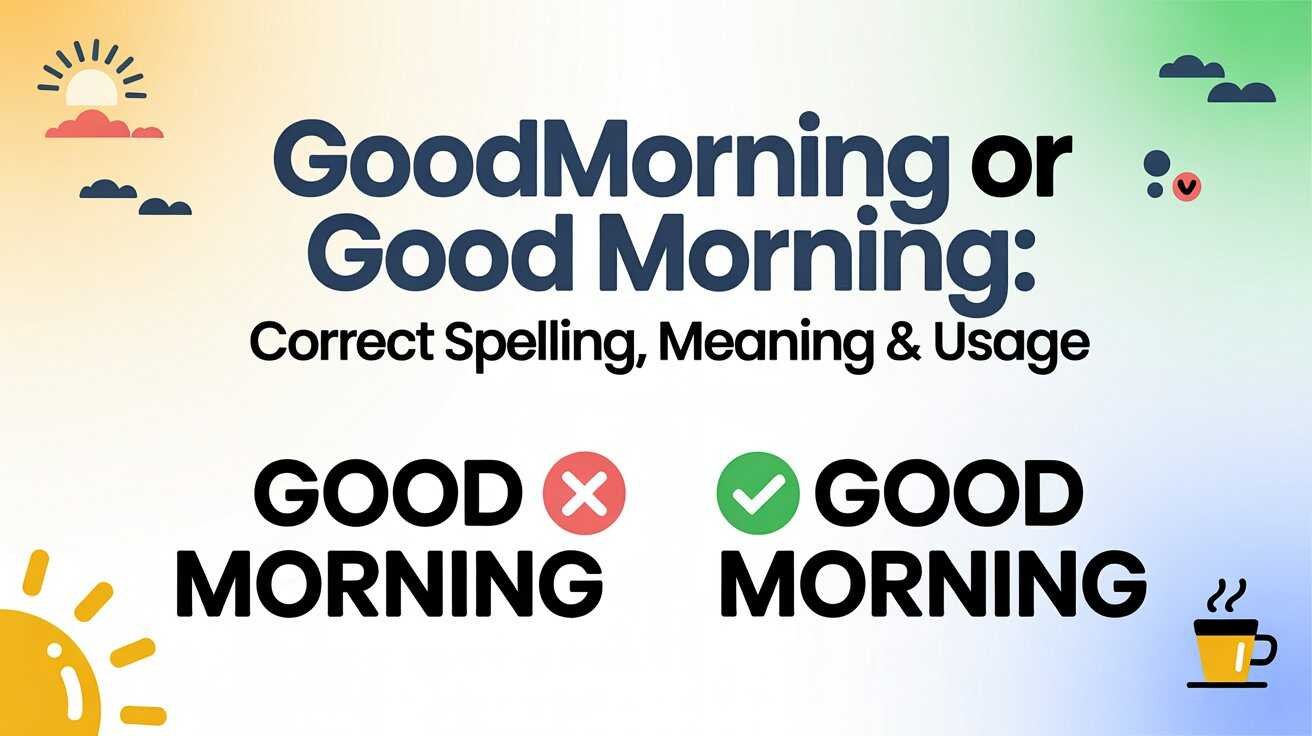
Goodmorning or Good Morning: Correct Spelling, Meaning & Usage
Goodmorning or good morning is a common question in English writing that confuses many people. While it might seem like a simple greeting, the difference between writing it as one word or two changes everything. The correct spelling is “good morning”, written as two separate words. Writing it as “goodmorning” is a mistake, even though you might see it in informal messages or on social media. Understanding the correct usage, spelling, and context will help you communicate clearly in emails, texts, and formal writing.
This article explains the correct usage of good morning, why “goodmorning” is incorrect, and how to use this phrase properly in everyday communication, professional settings, and digital platforms.
What Is the Correct Spelling: “Goodmorning” or “Good Morning”?
Many people often wonder whether to write “goodmorning” as one word or “good morning” as two separate words. The truth is that the correct spelling is always “good morning”, with a space between the adjective good and the noun morning. Writing it as a single word, “goodmorning”, is considered incorrect in formal and standard English, even though it sometimes appears in casual texts or social media. Understanding this distinction is essential for proper grammar, clear communication, and professional writing.
The Official Spelling
The official, dictionary-approved spelling is “good morning”. This phrase is recognized globally as a polite greeting used in the morning. “Goodmorning” is never accepted in formal writing, emails, or publications.
Why “Goodmorning” Is Incorrect
“Goodmorning” merges two words that serve different grammatical purposes. “Good” is an adjective describing the noun “morning.” In English, adjectives modify nouns but do not form a single word unless the phrase evolves into a compound over time, which has not happened with good morning.
Examples of Correct and Incorrect Usage
| Sentence | Correct Word | Incorrect Word |
|---|---|---|
| Greeting your colleague in the morning | Good morning, Sarah! | Goodmorning, Sarah! |
| Starting an email professionally | Good morning, Mr. Smith | Goodmorning, Mr. Smith |
| Texting a friend informally | Good morning! Are you awake? | Goodmorning! Are you awake? |
Grammar Rules Behind “Good Morning”
Understanding the grammar rules behind “good morning” helps explain why it is always written as two words. In this phrase, “good” is an adjective that describes the noun “morning”, which is why combining them into “goodmorning” is grammatically incorrect.
English has many compound words and open compounds, but “good morning” remains an open compound, meaning the words stay separate while working together to convey a single idea. Knowing these rules ensures you use this common greeting correctly in everyday speech, writing, and professional communication.
Why It Is a Two-Word Expression
In English grammar, “good” is an adjective and “morning” is a noun. Combining them into one word violates standard grammatical rules. Compound words often form over time, but “good morning” has remained an open compound for centuries.
Compound Words vs Open Compounds
An open compound is two words used together as a single concept but not merged. For example, “high school” and “full moon” are open compounds, just like “good morning.”
When Words Are Combined in English
English often combines words to create new meanings, like “notebook” or “sunflower.” However, “good morning” has never evolved into a single word. Treat it as two words in all writing.
When Should You Capitalize “Good Morning”?
Knowing when to capitalize “good morning” is just as important as spelling it correctly. In English, capitalization depends on context. You should capitalize both words when the phrase begins a sentence, appears in a greeting in emails, or is used in titles and headings.
In the middle of a sentence, however, it is usually written in lowercase unless it’s part of a proper noun or formal address. Understanding these rules helps you maintain professionalism in writing while keeping your greetings clear and grammatically correct.
Capitalization in Letters & Emails
Always capitalize the first letters when starting a sentence or a formal greeting. For example, “Good morning, Dr. Lee.” In emails, this is standard etiquette.
Capitalizing in Titles
If “good morning” appears in a title or heading, capitalize both words: “Good Morning Messages to Send Today.”
Table: Capitalization Rules
| Context | Correct Form | Example |
|---|---|---|
| Beginning of sentence | Good morning | Good morning! How are you? |
| Email greeting | Good morning | Good morning, team. |
| Article title | Good Morning | 10 Good Morning Quotes to Inspire You |
| Mid-sentence | good morning | I wish you a good morning on your birthday. |
READ MORE >>> Preform vs Perform: Meaning, Difference, Examples & Correct Usage
How to Use “Good Morning” Correctly in Sentences
Everyday Speech
Use “good morning” as a polite greeting. Examples:
- “Good morning! Did you sleep well?”
- “Good morning, everyone. Let’s start the meeting.”
Text Messages & Social Media
Informal messages often shorten greetings, but avoid writing “goodmorning”. Correct usage:
- “Good morning! ☀️”
- “Good morning, hope you have a great day.”
Emails & Professional Writing
Use “good morning” at the start of emails and letters. Examples:
- “Good morning, Mr. Johnson. I hope you are doing well.”
- “Good morning team, here’s today’s agenda.”
Common Mistakes People Make with “Good Morning”
Writing “Goodmorning”
Merging the words is common on social media or texting, but it is grammatically incorrect in any formal context.
Adding Hyphens
Some people incorrectly write “good-morning.” This is unnecessary unless used stylistically, like in creative writing.
Unnecessary Capital Letters
Writing “GOOD MORNING” in all caps is acceptable for emphasis in texting, but it’s not standard grammar.
Regional Differences: Is “Goodmorning” Ever Accepted?
Even globally, including American English and British English, the one-word spelling is not recognized. Informal texting may show “goodmorning,” but professional and academic writing always uses “good morning.”
“Good Morning” in Formal Writing — Do’s and Don’ts
Email Etiquette Rules
Start emails with “Good morning” when addressing colleagues or clients. Avoid merging the words.
Punctuation After “Good Morning”
Use a comma after the greeting:
- “Good morning, Dr. Smith.”
When to Write “Good Morning,” “Morning,” or “Good Day”
- Good morning: Standard greeting in the morning
- Morning: Casual, informal among friends
- Good day: Formal or British English usage, less common in the US
Alternatives to “Good Morning” (With Meanings)
Formal Alternatives
- “Greetings” – Professional, formal email or letter
- “Hello” – Neutral greeting
Informal Alternatives
- “Hey” – Casual among friends
- “Morning!” – Shortened, friendly greeting
Creative / Friendly Alternatives
- “Rise and shine!” – Cheerful morning greeting
- “Top of the morning!” – Traditional phrase, playful
A Quick Comparison Table: Goodmorning vs Good Morning
| Feature | Good Morning | Goodmorning |
|---|---|---|
| Spelling | Correct | Incorrect |
| Grammar | Adjective + Noun | Merged, incorrect |
| Formal Usage | Yes | No |
| Informal Usage | Yes | Social media only |
| Examples | Good morning, everyone! | Goodmorning, everyone! ❌ |
The Etymology of “Good Morning”
The phrase “good morning” dates back centuries in English literature. It has always been two words. “Good” is an adjective describing the time of day, and “morning” is a noun. Unlike words like “notebook” or “sunflower,” “good morning” never became a single compound word.
Digital Communication and One-Word Mistakes
With texting and social media, merging words is common. People write “goodmorning” for speed or style. While it may appear in casual contexts, it’s not acceptable in formal writing. Always stick to “good morning” for professional, academic, and grammatical correctness.
Commonly Confused Greeting Words Similar to “Good Morning”
Other phrases often confused with their one-word versions include:
- Goodnight vs Good night
- Anytime vs Any time
- Everyday vs Every day
Correct spelling follows the same adjective + noun rules, making it easy to remember.
Frequently Asked Questions (FAQs)
1. Is “goodmorning” ever acceptable?
No, it is incorrect in all formal contexts. Only used informally online.
2. Why do some people write “goodmorning”?
It’s faster for texting or social media posts, but grammatically wrong.
3. Do you capitalize “good morning” in emails?
Yes, capitalize both words when starting a sentence or greeting.
4. Is “Good Morning Everyone” correct?
Yes, but always capitalize “Good” and “Morning,” and place a comma before “everyone”: “Good morning, everyone.”
5. Should I say “good morning” or “good day”?
“Good morning” is standard in the morning. “Good day” is less common and formal, mainly in British English.
Conclusion
The final answer to goodmorning or good morning is clear: the correct spelling is “good morning”, written as two words. Writing it as “goodmorning” is incorrect, even though it is sometimes seen in texting or social media. Remember the rules: adjective + noun, proper capitalization, and correct punctuation. By following these simple guidelines, you can greet people politely, write professional emails, and avoid common mistakes. Always choose “good morning” for clear, grammatically correct communication.